
Burundi
Republic of Burundi
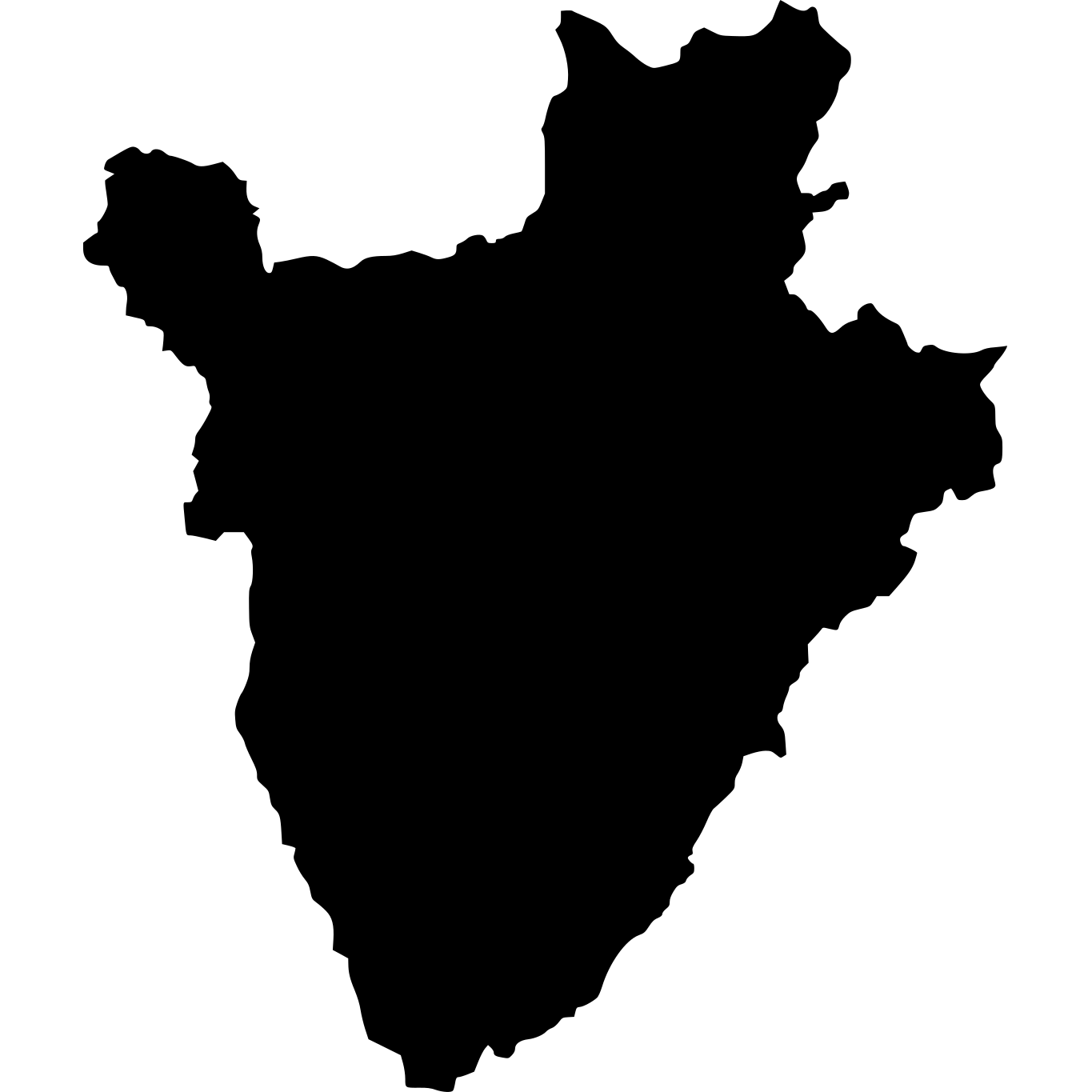
Burundi is one of Africa's smallest and poorest economies, dependent on subsistence agriculture, coffee and tea exports. The mining sector (nickel at Musongati, gold, rare earths) offers growth potential but remains underdeveloped. The economy faces challenges including limited infrastructure, political tensions, and international sanctions history. EAC membership (joined 2007) provides access to regional markets. The government is pursuing economic reforms and reengagement with international partners.
Snapshot
World Bank Indicators Compare with another country
Climate Readiness Full ranking
How this is computed
Adaptive capacity to absorb climate finance and adapt, following the readiness dimension of the ND-GAIN framework. Built only from measured values already held on each country profile. It is not a measure of emissions or physical climate vulnerability, which the platform does not yet hold.
- Energy access (30%) — World Bank, access to electricity (% of population). The single most climate and energy specific signal held: SDG 7 and the clean-energy transition.
- Governance readiness (20%) — Transparency International, Corruption Perceptions Index (0-100). ND-GAIN governance readiness: the capacity to govern and deploy climate finance. Higher is cleaner.
- Human readiness (20%) — UNDP, Human Development Index (0-1). ND-GAIN social readiness: the adaptive capacity of the population.
- Economic readiness (15%) — World Bank, GDP per capita (current US$), latest measured year. ND-GAIN economic readiness: the capacity to finance adaptation. Scored relative to the covered set.
- Digital readiness (15%) — World Bank, individuals using the Internet (% of population). Information systems for early warning and adaptation.
A country is scored only when at least 4 of the five indicators are held. Sub-scores are weighted and renormalised over the indicators that are present; nothing is estimated for one that is absent.
Country Facts
Focus Sectors
Regulations & Taxes
Business Directory (125)
View AllCOMASET
BusinessNYANDWI STANISLAS
BusinessGETRACO
BusinessBASE INGENIERIE
BusinessINNOVATION CONSTRUCTION AND GENERAL COMMERCE (ICGC)
BusinessGENERAL BUSINESS AFRICA
BusinessSOCIÉTÉ FATALE, ALLIANCE ET IDEALE "SFAI"
BusinessINFOCOG
BusinessSOCIETE VISION
BusinessSOCIETE HOPA
BusinessR P CONSULT
BusinessLE PROGRES TRADING COMPANY
BusinessTenders
View AllBRB -Recrutement d’un cabinet chargé d’assurer les formations sur : certified payment messaging expert (CPME)
Ministry of Communication, Information Technology and Media - Executive Secretariat for ICT (SETIC)
BRB-Recrutement d’un cabinet chargé d’assurer les formations sur: 3D secure
Ministry of Communication, Information Technology and Media - Executive Secretariat for ICT (SETIC)
BRB-recrutement d’un cabinet charge d’assurer les formations sur : certified payment processing specialist (CPPS)
Ministry of Communication, Information Technology and Media - Executive Secretariat for ICT (SETIC)
BRB-: Recrutement d’un cabinet chargé d’assurer les formations sur certified international payment systems professional (CIPSP)
Ministry of Communication, Information Technology and Media - Executive Secretariat for ICT (SETIC)