Tunisia
Republic of Tunisia
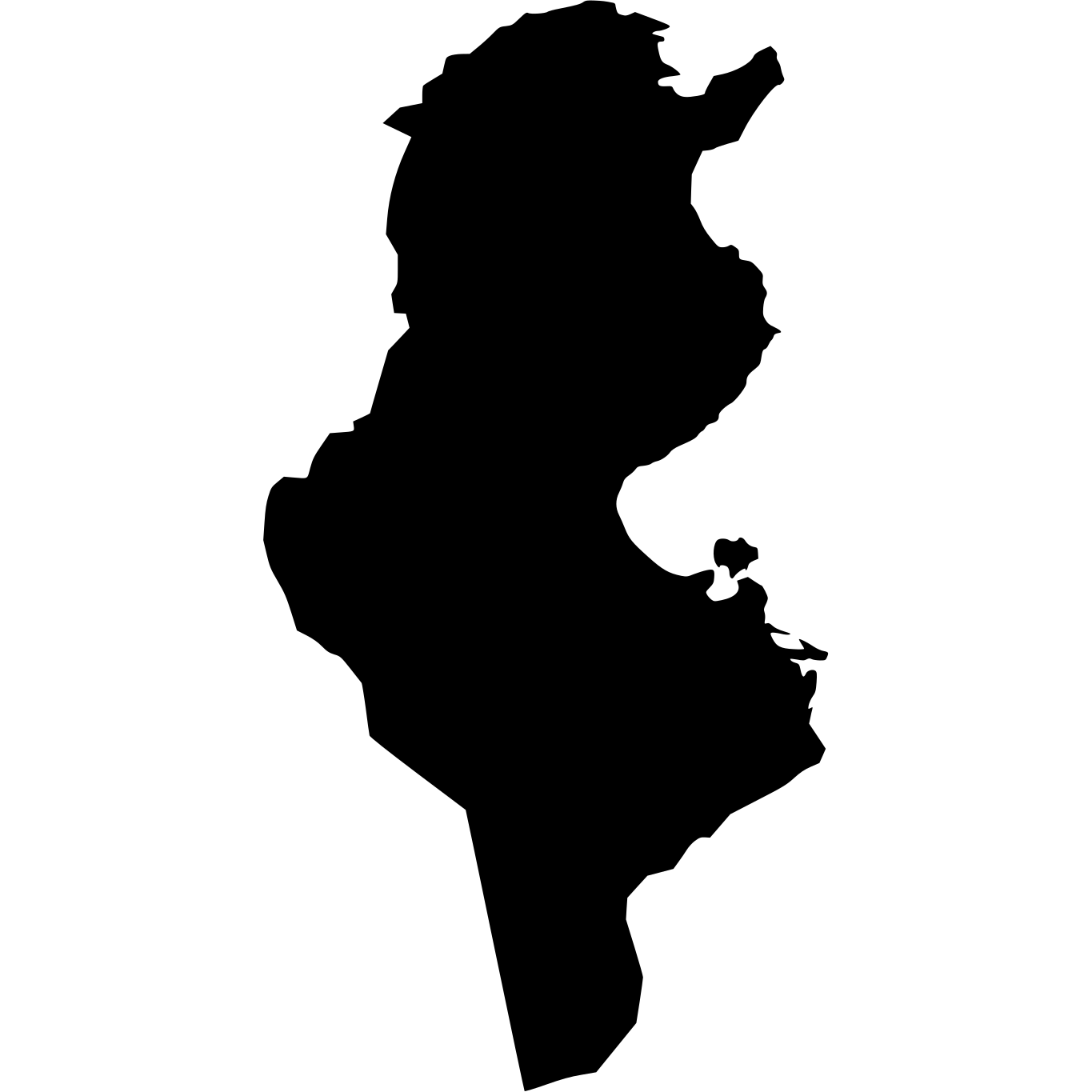
Tunisia is a diversified North African economy with strong manufacturing, tourism, and agricultural sectors. The country has a well-educated workforce and close economic ties to the European Union, particularly France, Italy, and Germany. Tunisia is a major manufacturer of auto parts, electronic components, textiles, and olive oil (world's fourth-largest producer).
The country's proximity to Europe (2 hours by air to major EU cities) and competitive labor costs make it attractive for nearshoring. The offshore sector benefits from a preferential tax regime. The Tunis Stock Exchange (BVMT) is one of North Africa's most active bourses.
Since the 2011 revolution, Tunisia has faced economic challenges including fiscal deficits, high youth unemployment, and political uncertainty. Relations with international lenders (IMF) are complex, with a $1.9 billion loan program stalled over reform conditionality.
Snapshot
World Bank Indicators Compare with another country
Climate Readiness Full ranking
How this is computed
Adaptive capacity to absorb climate finance and adapt, following the readiness dimension of the ND-GAIN framework. Built only from measured values already held on each country profile. It is not a measure of emissions or physical climate vulnerability, which the platform does not yet hold.
- Energy access (30%) — World Bank, access to electricity (% of population). The single most climate and energy specific signal held: SDG 7 and the clean-energy transition.
- Governance readiness (20%) — Transparency International, Corruption Perceptions Index (0-100). ND-GAIN governance readiness: the capacity to govern and deploy climate finance. Higher is cleaner.
- Human readiness (20%) — UNDP, Human Development Index (0-1). ND-GAIN social readiness: the adaptive capacity of the population.
- Economic readiness (15%) — World Bank, GDP per capita (current US$), latest measured year. ND-GAIN economic readiness: the capacity to finance adaptation. Scored relative to the covered set.
- Digital readiness (15%) — World Bank, individuals using the Internet (% of population). Information systems for early warning and adaptation.
A country is scored only when at least 4 of the five indicators are held. Sub-scores are weighted and renormalised over the indicators that are present; nothing is estimated for one that is absent.
Country Facts
Focus Sectors
Regulations & Taxes
Business Directory (200)
View AllKHALFALLAH MOHAMED
BusinessMARITEC
BusinessBFI INTERNATIONAL
BusinessKEYSTONE GROUP
BusinessDEVOTEAM
BusinessXTENSUS
BusinessSTE GESTION TRANSPORT INTERNATIONAL SGTI
BusinessSOCIÉTÉ D'EQUIPEMENT ELECTRIQUE ET TECHNIQUE- SEET
BusinessSOTUEC
BusinessENERTEAM
BusinessENTREPRISE AYADI WAEL
BusinessMED AMINE GHRIBI
BusinessRecent Deals (6)
View All DealsTenders
View AllDemande d’offre de prix – Organisation d’une réunion avec hébergement en demi-pension dans le Grand Tunis (09–13 novembre 2026)
WHO
Prestations hôtelières et logistiques pour des sessions de formation – Tunis, Sousse et Sfax (octobre–décembre 2026)
WHO
RFQ30000034627 équipements informatiques automatisation industrielle
IOM
LA REALISATION D'UNE ENQUETE NATIONALE SUR L'INCLUSION FINANCIERE ET LA DIGITALISATION DES SERVICES FINANCIERS.
EXPERTISE FRANCE
Contract Awards
View AllDéveloppement et mise en place d’un nouveau Système d’Information de l’Identifiant Social au profit du Centre de Recherches et d’Etudes Sociales (CRES)
Government of Tunisia (World Bank-financed, project P168425)
Conception et mise en œuvre d'une plateforme décisionnelle et data analytique
Government of Tunisia (World Bank-financed, project P168425)
Conception, Fourniture et Montage des liaisons 400 kV ( Mlaabi-Grombalia2-Mornaguia)
Government of Tunisia (World Bank-financed, project P179240)