
Republic of the Congo
Republic of the Congo
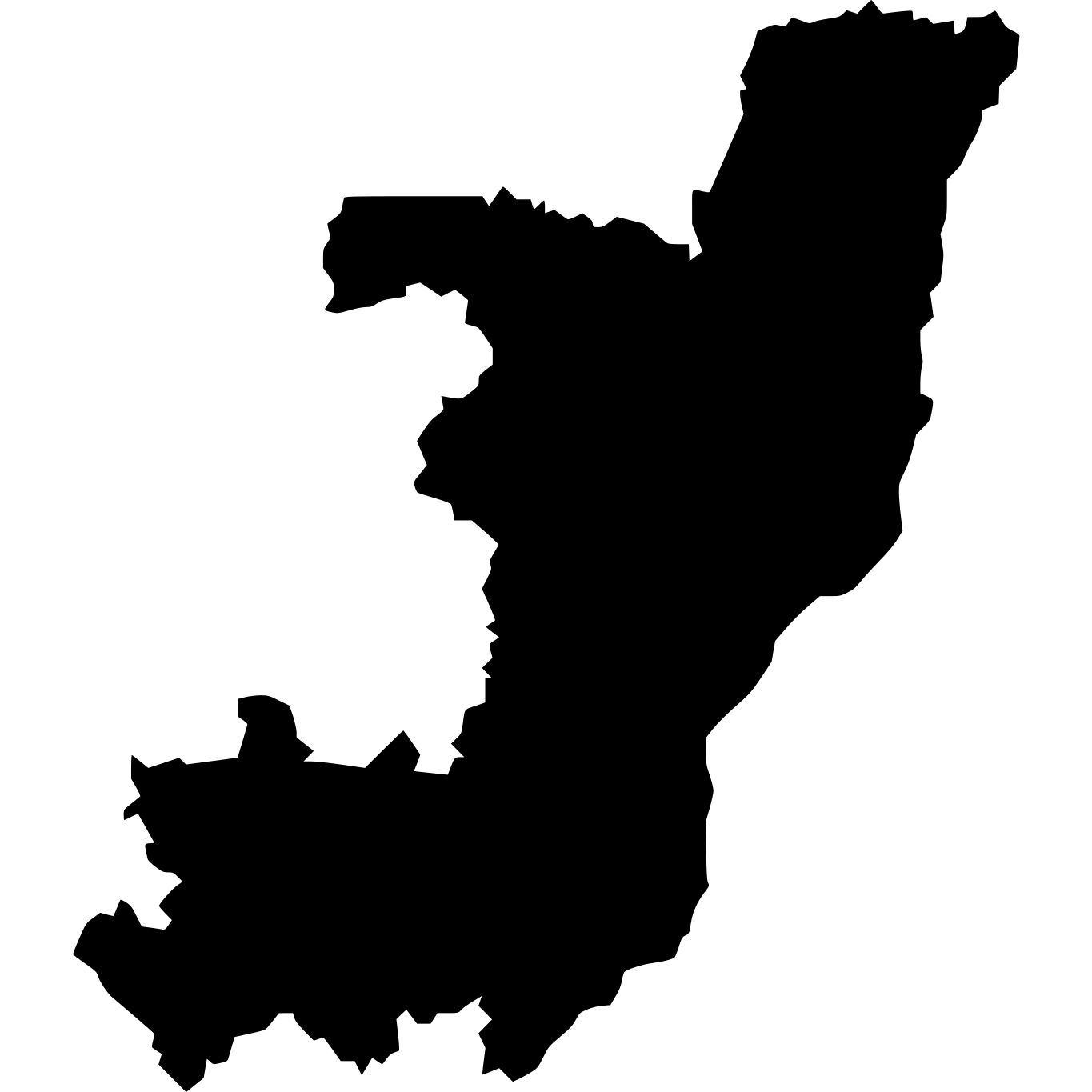
The Republic of Congo (Congo-Brazzaville) is a significant oil producer, with hydrocarbons accounting for over 80% of government revenue and exports. TotalEnergies, ENI, and Chevron operate major fields. The economy also depends on forestry (second-largest tropical forest in Africa), mining (potash, iron ore potential), and agriculture. The Pointe-Noire port is the country's economic hub and oil industry base. Challenges include heavy oil dependence, limited economic diversification, governance concerns, and infrastructure needs. The country's forest resources and potential in mining (iron ore at Mayoko-Moussondji) offer diversification opportunities.
Snapshot
World Bank Indicators Compare with another country
Climate Readiness Full ranking
How this is computed
Adaptive capacity to absorb climate finance and adapt, following the readiness dimension of the ND-GAIN framework. Built only from measured values already held on each country profile. It is not a measure of emissions or physical climate vulnerability, which the platform does not yet hold.
- Energy access (30%) — World Bank, access to electricity (% of population). The single most climate and energy specific signal held: SDG 7 and the clean-energy transition.
- Governance readiness (20%) — Transparency International, Corruption Perceptions Index (0-100). ND-GAIN governance readiness: the capacity to govern and deploy climate finance. Higher is cleaner.
- Human readiness (20%) — UNDP, Human Development Index (0-1). ND-GAIN social readiness: the adaptive capacity of the population.
- Economic readiness (15%) — World Bank, GDP per capita (current US$), latest measured year. ND-GAIN economic readiness: the capacity to finance adaptation. Scored relative to the covered set.
- Digital readiness (15%) — World Bank, individuals using the Internet (% of population). Information systems for early warning and adaptation.
A country is scored only when at least 4 of the five indicators are held. Sub-scores are weighted and renormalised over the indicators that are present; nothing is estimated for one that is absent.
Country Facts
Focus Sectors
Regulations & Taxes
Business Directory (79)
View AllPEFACO HOTEL
BusinessCONSO PLUS
BusinessBL TECHNOLOGY
BusinessLE QUE FAIRE
BusinessBIG SMART
BusinessKPMG-CONGO
BusinessMILAN PRINT
BusinessAGETIP-EW
BusinessRAZEL-BEC
BusinessEAU ET ASSAINISSEMENT POUR L'AFRIQUE (EAA)
BusinessASSOCIATION ACTION POUR LE DÉVELOPPEMENT INTÉGRAL (AADI)
BusinessGROUPEMENT AGROPASTORALE DE BRAZZAVILLE (GAPB)
BusinessContract Awards
View AllContrat par entente direct avec MTN por l'opérationalisation du numéro vert du PASEL
Government of Congo, Republic of (World Bank-financed, project P501343)
RECRUTEMENT D'UN CONSULTANT NATIONAL POUR L'ELABORATION D'UN PLAN D'ACTION POUR ELARGIR LES OPPORTUNITES D'APPRENTISSAGE PRECOCE COUVRANT DES ACTIONS CLES EN VUE D'EN AMELIORER L'ACCES, LA QUALITE...
Government of Congo, Republic of (World Bank-financed, project P179410)
ACQUISITION DES FOURNITURES DE BUREAU ET AUTRES FOURNITURES
Government of Congo, Republic of (World Bank-financed, project P179410)
Contrat d'Assurance maladie au profit du personnel de PAGIR
Government of Congo, Republic of (World Bank-financed, project P177468)