The Gambia
Republic of The Gambia
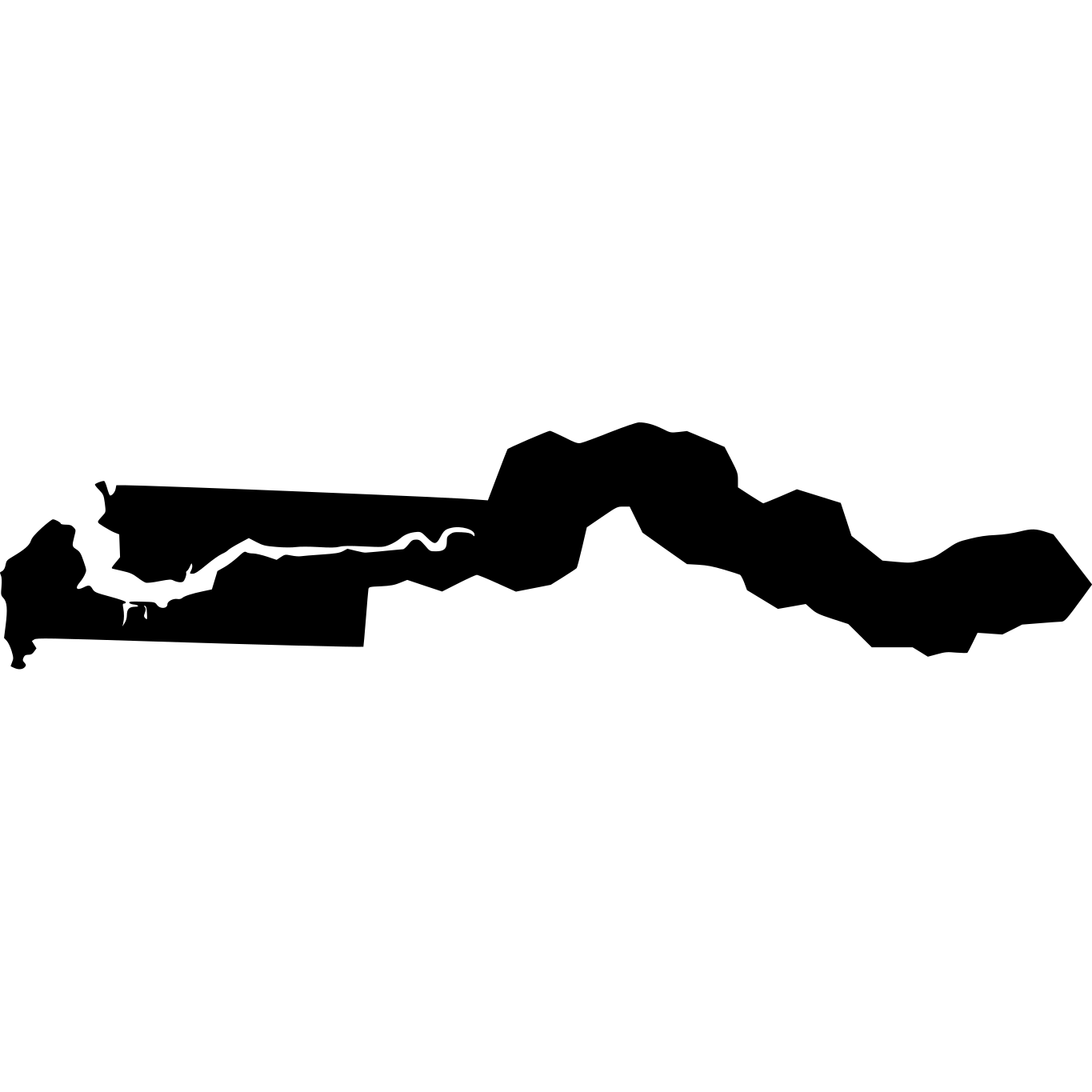
The Gambia is the smallest mainland African country, with an economy dependent on tourism (particularly European winter sun seekers), agriculture (peanuts/groundnuts), re-export trade, and remittances. The country's location along the Gambia River provides access to inland markets. Since the 2017 democratic transition, The Gambia has improved governance and attracted renewed international support. The country benefits from ECOWAS market access and an English-speaking workforce. Challenges include a very small domestic market, limited infrastructure, and vulnerability to climate change and tourism seasonality.
Snapshot
World Bank Indicators Compare with another country
Climate Readiness Full ranking
How this is computed
Adaptive capacity to absorb climate finance and adapt, following the readiness dimension of the ND-GAIN framework. Built only from measured values already held on each country profile. It is not a measure of emissions or physical climate vulnerability, which the platform does not yet hold.
- Energy access (30%) — World Bank, access to electricity (% of population). The single most climate and energy specific signal held: SDG 7 and the clean-energy transition.
- Governance readiness (20%) — Transparency International, Corruption Perceptions Index (0-100). ND-GAIN governance readiness: the capacity to govern and deploy climate finance. Higher is cleaner.
- Human readiness (20%) — UNDP, Human Development Index (0-1). ND-GAIN social readiness: the adaptive capacity of the population.
- Economic readiness (15%) — World Bank, GDP per capita (current US$), latest measured year. ND-GAIN economic readiness: the capacity to finance adaptation. Scored relative to the covered set.
- Digital readiness (15%) — World Bank, individuals using the Internet (% of population). Information systems for early warning and adaptation.
A country is scored only when at least 4 of the five indicators are held. Sub-scores are weighted and renormalised over the indicators that are present; nothing is estimated for one that is absent.
Country Facts
Focus Sectors
Regulations & Taxes
Business Directory (142)
View AllPROFESSIONAL CLIENT SERVICES HYDROTECH
BusinessRATOU GENERAL MERCHANDISE
BusinessTORODO CHAMBERS AND ULTIMATE PARTNERS
BusinessDANYANKO COMPANY
BusinessALL FOR AGRO
BusinessAUGUSTUS PROM – AUDIT. TAX. ADVISORY. (A.P.)
BusinessTOUNETS GENERAL MACHANDISE
BusinessMTECH SOLUTIONS
BusinessSUSTAINABLE DEVELOPMENT FOCUS, SD FOCUS
BusinessIYKE CHRIST COMPUTERS
Business2IRIS GAMBIA
BusinessLOBSAN ENTERPRISE
BusinessTenders
View AllDevelopment of a systematic customary land rights registration pilot
Gambia Ministry of Agriculture - Central Projects Coordination Unit
Selection of Consultancy Services for Detailed Engineering Design and Construction Supervision of: Water Supply Systems; and The Kotu Faecal Sludge Treatment Plant, together with the Rehabilitation of Sanitation Infrastructure in Kotu and Banjul.
NATIONAL WATER AND ELECTRICITY COMPANY
Contract Awards
View AllSupply of Electricity by SENELEC to The Gambia through NAWEC
Government of Gambia, The (World Bank-financed, project P516627)
Consultancy for Productive Economic Inclusion (Pei) Program Pilot Phase Process Evaluation in The Gambia
Government of Gambia, The (World Bank-financed, project P179233)
Consultancy for spot check and process evaluation in URR
Government of Gambia, The (World Bank-financed, project P179233)
Evaluation of rennovation works
Government of Gambia, The (World Bank-financed, project P179233)