Guinea
Republic of Guinea
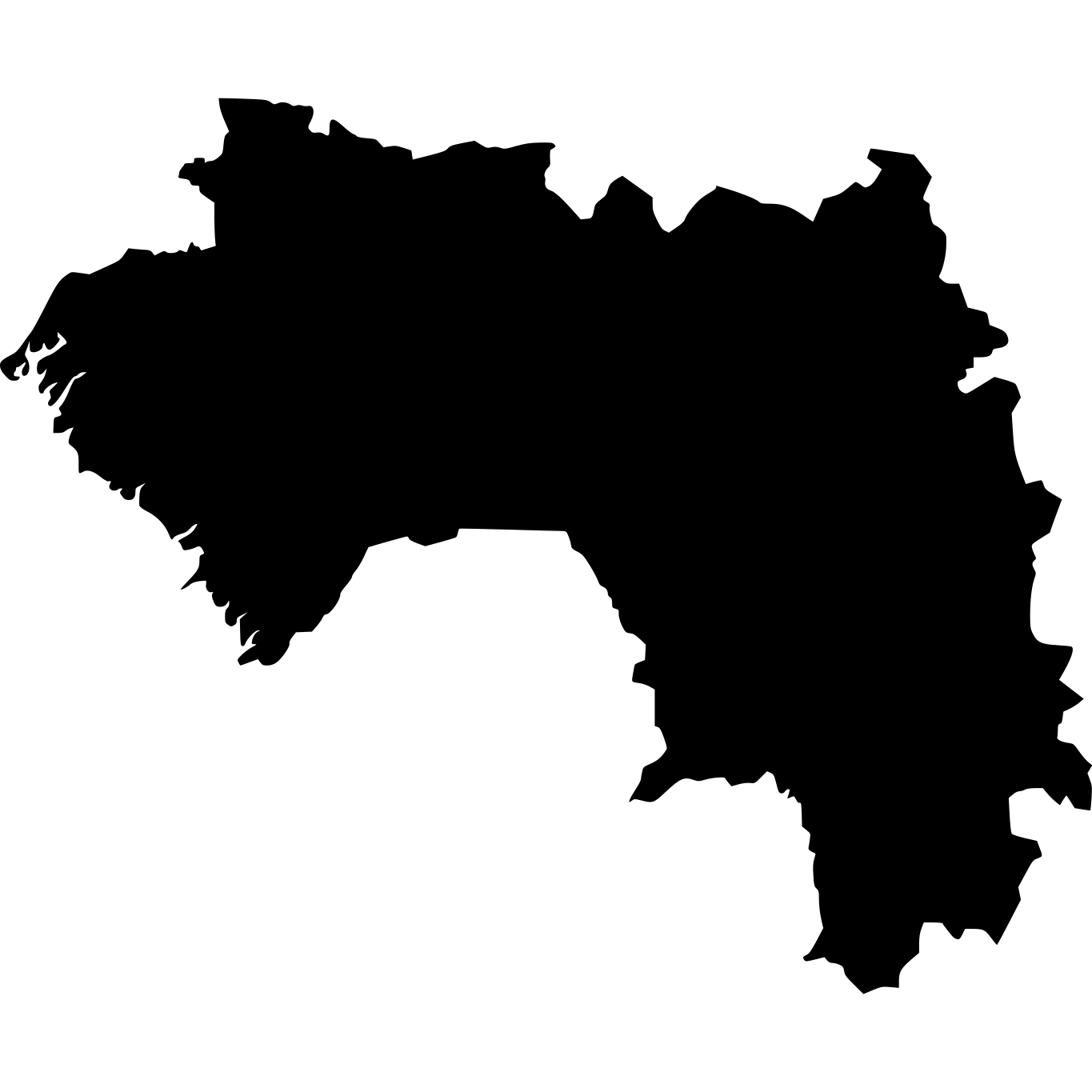
Guinea holds the world's largest bauxite reserves and is among the top global producers, with major operations by Guinea Alumina Corporation (EGA/Mubadala), Societe Miniere de Boke (SMB/Winning Consortium), and Compagnie des Bauxites de Guinee (CBG). The Simandou iron ore deposit in southeastern Guinea is the world's largest untapped high-grade iron ore reserve, with the Rio Tinto/Winning consortium developing blocks 3-4 and blocks 1-2.
Mining dominates the economy, alongside agriculture (rice, coffee, palm oil), fisheries, and hydropower potential. Guinea has significant undeveloped gold and diamond resources. The country is governed by a military transitional government following the September 2021 coup.
Challenges include political uncertainty regarding the democratic transition timeline, infrastructure deficits (particularly road and rail to mining sites), limited electricity access, and weak governance institutions.
Snapshot
World Bank Indicators Compare with another country
Climate Readiness Full ranking
How this is computed
Adaptive capacity to absorb climate finance and adapt, following the readiness dimension of the ND-GAIN framework. Built only from measured values already held on each country profile. It is not a measure of emissions or physical climate vulnerability, which the platform does not yet hold.
- Energy access (30%) — World Bank, access to electricity (% of population). The single most climate and energy specific signal held: SDG 7 and the clean-energy transition.
- Governance readiness (20%) — Transparency International, Corruption Perceptions Index (0-100). ND-GAIN governance readiness: the capacity to govern and deploy climate finance. Higher is cleaner.
- Human readiness (20%) — UNDP, Human Development Index (0-1). ND-GAIN social readiness: the adaptive capacity of the population.
- Economic readiness (15%) — World Bank, GDP per capita (current US$), latest measured year. ND-GAIN economic readiness: the capacity to finance adaptation. Scored relative to the covered set.
- Digital readiness (15%) — World Bank, individuals using the Internet (% of population). Information systems for early warning and adaptation.
A country is scored only when at least 4 of the five indicators are held. Sub-scores are weighted and renormalised over the indicators that are present; nothing is estimated for one that is absent.
Country Facts
Focus Sectors
Regulations & Taxes
Business Directory (153)
View AllTenders
View AllService de Maitrise d'oeuvre pour le contrôle et la surveillance des travaux de construction de l'Usine d'eau potable de Yessolou IV, des ouvrages d'adduction d'eau traitée, des reservoirs et reseau de distribution (Lots de travaux 1 à 4)
Société des Eaux de Guinée (SEG-SA)
Service de maitrise d'oeuvre pour le contrôle et la surveillance des travaux de construction des reservoirs et reseau de distribution (Lots de travaux 5 à 8)
Société des Eaux de Guinée (SEG-SA)
Recrutement d'un cabinet pour l'Audit externe de projet et du PPA.
Guinea - Kounki project - Climate resilience, fisheries and aquaculture
Contract Awards
View AllContrat pour l’acquisition de pneumatique par marché à commande des véhicules des projets au sein de l’UGP
Government of Guinea (World Bank-financed, project P506072)
Contrat de la mise en œuvre des activités génératrices de revenus (AGR) dans la périphérie du Futur Parc National Marin des Iles de Loos
Government of Guinea (World Bank-financed, project P168613)
Réalisation d’une Evaluation Environnementale et Sociale Stratégique (EESS) relative à l’extension du réseau national d’aires protégées de la République de Guinée
Government of Guinea (World Bank-financed, project P168613)
Etudes, le suivi et le contrôle des travaux de la réalisation des bases-vies de Boké, Boffa et Forécariah
Government of Guinea (World Bank-financed, project P168613)