
Mali
Republic of Mali
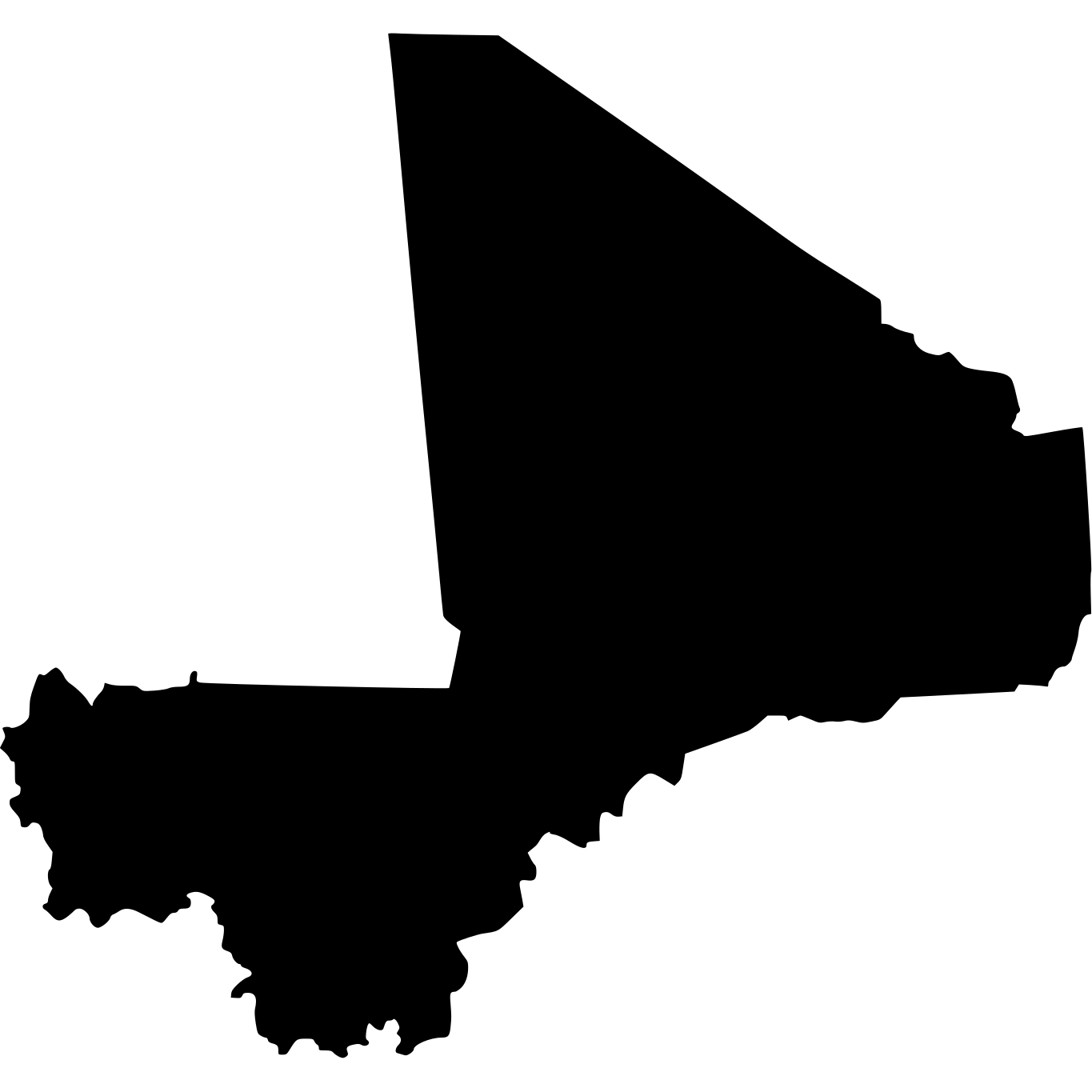
Mali is Africa's third-largest gold producer, with major operations by B2Gold, Barrick Gold, and Resolute Mining. Gold accounts for approximately 70% of export earnings. The economy also depends on agriculture (cotton, rice, livestock) and the informal sector.
Following military coups in 2020 and 2021, Mali withdrew from ECOWAS and has reoriented its security partnerships, impacting international relations and aid flows. The country operates within the CFA franc zone (WAEMU), providing currency stability despite political upheaval.
The business environment is challenging due to security concerns in the northern and central regions, political uncertainty, and infrastructure deficits. The API-Mali investment agency continues to operate. The mining sector remains operational and attractive, with new exploration licenses being issued. Mali's young population (median age 16) and agricultural potential offer long-term opportunities.
Snapshot
World Bank Indicators Compare with another country
Climate Readiness Full ranking
How this is computed
Adaptive capacity to absorb climate finance and adapt, following the readiness dimension of the ND-GAIN framework. Built only from measured values already held on each country profile. It is not a measure of emissions or physical climate vulnerability, which the platform does not yet hold.
- Energy access (30%) — World Bank, access to electricity (% of population). The single most climate and energy specific signal held: SDG 7 and the clean-energy transition.
- Governance readiness (20%) — Transparency International, Corruption Perceptions Index (0-100). ND-GAIN governance readiness: the capacity to govern and deploy climate finance. Higher is cleaner.
- Human readiness (20%) — UNDP, Human Development Index (0-1). ND-GAIN social readiness: the adaptive capacity of the population.
- Economic readiness (15%) — World Bank, GDP per capita (current US$), latest measured year. ND-GAIN economic readiness: the capacity to finance adaptation. Scored relative to the covered set.
- Digital readiness (15%) — World Bank, individuals using the Internet (% of population). Information systems for early warning and adaptation.
A country is scored only when at least 4 of the five indicators are held. Sub-scores are weighted and renormalised over the indicators that are present; nothing is estimated for one that is absent.
Country Facts
Focus Sectors
Regulations & Taxes
Business Directory (231)
View AllASSURANCES LAFIA SA
BusinessGLOBAL CENTRAL SARL
BusinessETABLISSEMENT SY ET FRERES
BusinessENTREPRISE MOHAMED OUMAR
BusinessELEPHANT VERT MALI-SA
BusinessGILI SOLUTION PARTAGEE
BusinessENTREPRISE KOUSSAM BTP
BusinessGUINDO SERVICES
BusinessSAPRONAT -TACA
BusinessCONDOR-SARL
BusinessEXCLUSIVE AFRICA GROUPE SARL
BusinessVISION COMMERCE
BusinessTenders
View AllContract Awards
View AllAcquisition de deux serveurs supplémentaires et équipements réseau pour l’ANTIM,
Government of Mali (World Bank-financed, project P503776)
Multiplier le guide et les supports de surveillance basés sur les évènements.
Government of Mali (World Bank-financed, project P503776)
Acquisition d’un logiciel pour le contrôle et la gestion des dépenses pour la CANAM.
Government of Mali (World Bank-financed, project P503776)
Acquérir de 2 kits de visioconférence pour la CTN et les ateliers.
Government of Mali (World Bank-financed, project P503776)